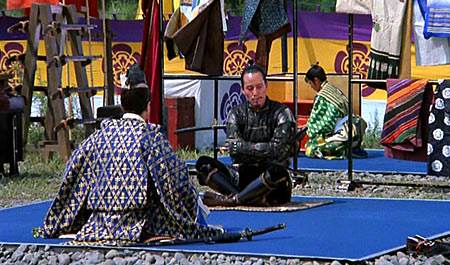
Some pictures now...
Another picture of the akunoya, a little wet from the rain. It has actually held up much better than I expected.
Clothes I made for Richard with Reconstructing History's Elizabethan Sea Dogs pattern... (ignore the man in fundoshi - I didn't make those). He still needs proper shoes, a hat, maybe a ruff and, if he's going to be Portuguese, a capelet. But it's a decent start.
My own clothes (missing waraji, and might benefit from arm and leg guards when it gets cold)
I have to show you my friends from Lotus no Chi too!
Showing posts with label re-enactment. Show all posts
Tuesday, August 24, 2010
Sunday, August 8, 2010
Projects coming together - finally
Remember the akunoya? Well, our friend didn't have all the pieces to put his carport together, so we had to buy another one. But it was half-price, and our friend's sides and top fit on our new cheaper carport. So, it's all good!
Here Richard is starting to paint the designs on the sides...
I made him two chemises, here's the second one I put together (slightly better than the first).
I REALLY wanted to make waraji sandals, but I won't have time. So, I bought zori instead. I think they look Japanese enough :-) I bought them from at Collection du Japon (where we are also taking Japanese language classes, with Uchiyama-sensei).
Here is what the akunoya shell looks like while I'm working on it. Ugh!
And we bought our bowls and plates. We found them at a Japanese/Korean Dollar Store/Grocery on Décarie just South of Sherbrooke (here, in fact).
We also bought a bed - frame + air mattress. Big problem. The mattress leaks. I'm SO glad we tested this beforehand! We're going to get a new, different one, tomorrow.
And, finally... here is the akunoya in all its glory!
Here Richard is starting to paint the designs on the sides...
Here is one of the designs all painted, drying.
I made him two chemises, here's the second one I put together (slightly better than the first).
I REALLY wanted to make waraji sandals, but I won't have time. So, I bought zori instead. I think they look Japanese enough :-) I bought them from at Collection du Japon (where we are also taking Japanese language classes, with Uchiyama-sensei).
Here is what the akunoya shell looks like while I'm working on it. Ugh!
And we bought our bowls and plates. We found them at a Japanese/Korean Dollar Store/Grocery on Décarie just South of Sherbrooke (here, in fact).
We also bought a bed - frame + air mattress. Big problem. The mattress leaks. I'm SO glad we tested this beforehand! We're going to get a new, different one, tomorrow.
And, finally... here is the akunoya in all its glory!
Saturday, July 31, 2010
Sweing, sewing, sewing...
I've been sewing like crazy these last few weeks. Clothes for me, clothes for Richard, and an akunoya...
No time to describe it... but some pictures!
And, below, are pieces of the akunoya, all cut to length (all that was left at that point was rip to the right width and assemble).
And, below, one new costume! Not perfect, there wasn't any time for that. Next one will be much better ;-) Ah, I made the sleeves removable so he can wear it at fantasy events in the summer!
That's it for today!
No time to describe it... but some pictures!
And, below, are pieces of the akunoya, all cut to length (all that was left at that point was rip to the right width and assemble).
And, below, one new costume! Not perfect, there wasn't any time for that. Next one will be much better ;-) Ah, I made the sleeves removable so he can wear it at fantasy events in the summer!
That's it for today!
Saturday, May 15, 2010
Japanese clothing
I've started making my clothes for Bicolline this summer.
I *know* that on extant paintings of the time, the majority of hats are the typical Chinese pointy hats... but I don't like the fact that they're so strongly associated with Chinese now... I've found better, if less period. For 3,50 a hat, I decided it would be good enough for now.
And, this is the fabric all cut out, with all the edges properly finished (the three on the left are linen, I don't want them to fray!). I had to cheat on the two left pieces and split the collar in the middle. I didn't have enough fabric.
I've started sewing, and hit a snag... the collar seam line, as it continues into the front body piece, and the sewing line for the overlap panel.
Both Saionji and Kass say to sew the overlap to the edge of the front panel, and the diagram in Dalby seems to agree.
But Marshal (I know, modern) tells us to sew the overlap to the collar sewing line, like this:
Trouble is, when I look at pictures of extant kosode in Momoyama: The Golden Age and Japanese Costume and Textile Arts, I think he might actually be right! The okumi sewing line seems to go right into the collar sewing line...
What shall I do?
Add-on: I asked the question on SCA-JML list and I'm not sure I can explain clearly... Here's another diagram...
A: The overlap (in red) is sewn right to the edge of the main body piece.
B: The overlap (in red) is offset from the edge and lines up with the collar sewing line (dotted line). This is the version I think I'm seeing on extant pieces.
I *know* that on extant paintings of the time, the majority of hats are the typical Chinese pointy hats... but I don't like the fact that they're so strongly associated with Chinese now... I've found better, if less period. For 3,50 a hat, I decided it would be good enough for now.
And, this is the fabric all cut out, with all the edges properly finished (the three on the left are linen, I don't want them to fray!). I had to cheat on the two left pieces and split the collar in the middle. I didn't have enough fabric.
I've started sewing, and hit a snag... the collar seam line, as it continues into the front body piece, and the sewing line for the overlap panel.
Both Saionji and Kass say to sew the overlap to the edge of the front panel, and the diagram in Dalby seems to agree.
But Marshal (I know, modern) tells us to sew the overlap to the collar sewing line, like this:
Trouble is, when I look at pictures of extant kosode in Momoyama: The Golden Age and Japanese Costume and Textile Arts, I think he might actually be right! The okumi sewing line seems to go right into the collar sewing line...
What shall I do?
Add-on: I asked the question on SCA-JML list and I'm not sure I can explain clearly... Here's another diagram...
A: The overlap (in red) is sewn right to the edge of the main body piece.
B: The overlap (in red) is offset from the edge and lines up with the collar sewing line (dotted line). This is the version I think I'm seeing on extant pieces.
A new dress for the little princess
Okay, she's not a princess in the SCA. Though she probably is in her mother's eyes!
I found tons of pink fabric I don't even remember buying, so I decided to make her a dress for our Crown Tourney (in the SCA).
I used La Fleur de Lyse pattern. Beware, the sleeves are short!
The hat was knitted by her mom, and the dress wasn't hemmed yet when the picture was taken. (I made a triple hem for when she grows!)
I found tons of pink fabric I don't even remember buying, so I decided to make her a dress for our Crown Tourney (in the SCA).
I used La Fleur de Lyse pattern. Beware, the sleeves are short!
The hat was knitted by her mom, and the dress wasn't hemmed yet when the picture was taken. (I made a triple hem for when she grows!)
Akunoya
So, on to the akunoya project.
Let me first refer you to two excellent web pages:
I was planning on making a vertically striped akunoya, but I finally changed my mind for two reasons: the leader of our group thought it looked too much like circus tents, and, most of all, a vertically striped akunoya would imply much more sewing, which I won't really have time to do this summer.
So, I settled on this design:
I'm starting from this carport (hey, it's free, so, even if the shape is not perfect, it will be good enough for us this year!)
I was planning on making a whole new shell for it, but I can't locate suitable canvas locally and ordering it online would be costly. It's the first time we go there, we don't know if we're going to want to go again next year, and with the shape of this thing not being ideal for an akunoya, I'm not sure it's worth making a whole complete waterproof replacement cover for it just yet.
What I will do instead is buy cheap broadcloth and make a quick shell to go over the plastic. We'll be dry, and if the weather is nice we can raise the sides and just leave the fabric hang down. If we like it, next year I'll make a better one and reuse the fabric for garb :-)
Let me first refer you to two excellent web pages:
- http://www.sengokudaimyo.com/miscellany/tents.html
(and the equivalent jinmaku page here http://www.sengokudaimyo.com/miscellany/curtains.html) - http://www.thefightschool.demon.co.uk/The_SHOGUN_Tent_Guide.htm
I was planning on making a vertically striped akunoya, but I finally changed my mind for two reasons: the leader of our group thought it looked too much like circus tents, and, most of all, a vertically striped akunoya would imply much more sewing, which I won't really have time to do this summer.
So, I settled on this design:
I'm starting from this carport (hey, it's free, so, even if the shape is not perfect, it will be good enough for us this year!)
I was planning on making a whole new shell for it, but I can't locate suitable canvas locally and ordering it online would be costly. It's the first time we go there, we don't know if we're going to want to go again next year, and with the shape of this thing not being ideal for an akunoya, I'm not sure it's worth making a whole complete waterproof replacement cover for it just yet.
What I will do instead is buy cheap broadcloth and make a quick shell to go over the plastic. We'll be dry, and if the weather is nice we can raise the sides and just leave the fabric hang down. If we like it, next year I'll make a better one and reuse the fabric for garb :-)
Monday, March 22, 2010
On to Japanese clothing - a followup
I received a few very helpful answers from the SCA-JML mailing list.
But first, a site I forgot to link to yesterday, the Wodeford Hall.
This page is about The Kosode: http://www.wodefordhall.com/kosode.htm
This one is about painting and printing fabric: http://www.wodefordhall.com/fakingit.htm
Now, on with the replies!
Saionji wrote:
Tekko and kyhana are for warmth or other protection. If you don't need them, don't bother.
Photo of me slumming at Pennsic two years ago, shows me in a single layer of linen with an obi that's a bit fancier than necessary. http://farm3.static.flickr.com/2234/2025863270_74473d5064.jpg
Note that this is a case of one of my regular kosode doing "double duty". It's big enough and long enough to wear as another layer with some of my others for an impression of higher status, but simple enough to wear as shown in the photo.
In general, peasant kosode will be a bit shorter - mid calf would not be an indecent length and you can achieve that either by hiking it up (as I did) or by cutting yours a little shorter, and maybe an inch narrower than someone of higher social status. Linen is a good substitute for hemp or ramie, two bast fibers which the Japanese had and which the lower classes wore.
Tasuke is a method of tying your sleeves out of the way. It's extremely practical and fairly easy to do once you know how. A strip of bias tape works great for this. Scroll down here to find a photo how-to:
http://www.mbdojo.com/basics.html
http://www.tnm.go.jp/gallery/search/images/max/C0022482.jpg is a detail from the great "Genre Scenes of the Twelve Months" screens in the Tokyo National Museum, dating from the 16th century. It shows women transplanting rice as musicians play and drum (a scene replicated at the end of Kurosawa's "Seven Samurai.") Note that hems are at the knee, sleeves bare the arms up to the elbow and if you look carefully, you'll see painted tasuke - it's easiest to pick out on the planters in black as their taske are red.
An accomplished textile artist can dye, weave or otherwise decorate the fabric in bolt form. I freely admit to cheating when I paint by cutting out my fabric and doing partial assembly so I can lay the thing out over a table and line things up as I apply the decoration.
When asked about Shogun, she said:
Caveat: Films are not documentation, though they can certainly get your inspirational juices flowing. I haven't actually seen "Shogun" since its network airing back in the day. However, I've gotten this question enough times that when a paperback "making-of" edition turned up at a local book store, I acquired it. There's a photo of the costume designer displaying one of his production sketches next to a book containing a 17th c. painting that I recognize. "Shogun" was a a cooperative collaboration between a U.S. and Japanese production company and they did a good job in terms of production design. The women's costumes, particularly the procession of pink, floral stuff worn by Yoko Shimada as Mariko, strikes me as the evolving 17th century style, particularly in regards to the width of obi (looks about 4" to me), worn tied in a soft bow at the back, and the softer, less stiff fabrics used.
I've been watching a lot of Kurosawa this month, thanks to a local film festival, and the period costuming in many of these can also serve as a point to start from. Here are some stills from "Hidden Fortress" of a young peasant woman, that match reasonably well with the rice pickers in the "Genre Scenes" screens as well as some of the Kyoto Costume Museum items you posted:
http://www.kurosawamovies.com/gallery/d/3019-2/hidden41.jpg
http://www.kurosawamovies.com/gallery/d/2995-2/hidden33.jpg
http://www.kurosawamovies.com/gallery/d/3025-2/hidden43.jpg has a better shot of her head wrap, which can be achieved using a square of fabric folded in half on a diagonal.
Then, booknerd9 (sorry, you didn't sign your name) wrote:
I wear a kosode and mobakama for pretty much everything. You can also tie the sleeves back and this keeps them out of the way quite well. However, if I'm in the kitchen, I tend to wear a mundane apron because I'm neurotic about getting stains on my garb (;
After that, I received another answer from Saionji:
The men's stuff from "Shogun," is not stylistically different from pre-Edo, but the women's clothing is definitely showing the evolution toward the newer styles.
And finally, after I said: I've been able to take a look at the Kurosawa pictures and I have a question. On this one: http://www.kurosawamovies.com/gallery/d/2995-2/hidden33.jpg. The sleeves appear incredibly narrow, almost like a tube sleeve, t-tunic style. I thought the sleeves look rather narrow too on the KCM pics. What do you think?, Ii answered the following:
"Kosode" can refer to either the tube-sleeve look or the more distinctive curve--it really seems to refer more to the opening of the sleeve mouth than the rest of the sleeve. That said, having a little extra fabric looks more posh, and became the standard. Looking closely at the image, this is a more traditional sleeve, with the curve, but you are looking at the bottom seam nearly head-on. Look at his left sleeve and you'll see the characteristic "v" tail shape, and you can follow the straight lines across to see that they are just all being pulled upwards. It is small and peasant-wear, but it is still there.
I think this pretty much answers all questions I had! I promise to write the next post myself ;-)
But first, a site I forgot to link to yesterday, the Wodeford Hall.
This page is about The Kosode: http://www.wodefordhall.com/kosode.htm
This one is about painting and printing fabric: http://www.wodefordhall.com/fakingit.htm
Now, on with the replies!
Saionji wrote:
Tekko and kyhana are for warmth or other protection. If you don't need them, don't bother.
Photo of me slumming at Pennsic two years ago, shows me in a single layer of linen with an obi that's a bit fancier than necessary. http://farm3.static.flickr.com/2234/2025863270_74473d5064.jpg
Note that this is a case of one of my regular kosode doing "double duty". It's big enough and long enough to wear as another layer with some of my others for an impression of higher status, but simple enough to wear as shown in the photo.
In general, peasant kosode will be a bit shorter - mid calf would not be an indecent length and you can achieve that either by hiking it up (as I did) or by cutting yours a little shorter, and maybe an inch narrower than someone of higher social status. Linen is a good substitute for hemp or ramie, two bast fibers which the Japanese had and which the lower classes wore.
Tasuke is a method of tying your sleeves out of the way. It's extremely practical and fairly easy to do once you know how. A strip of bias tape works great for this. Scroll down here to find a photo how-to:
http://www.mbdojo.com/basics.html
http://www.tnm.go.jp/gallery/search/images/max/C0022482.jpg is a detail from the great "Genre Scenes of the Twelve Months" screens in the Tokyo National Museum, dating from the 16th century. It shows women transplanting rice as musicians play and drum (a scene replicated at the end of Kurosawa's "Seven Samurai.") Note that hems are at the knee, sleeves bare the arms up to the elbow and if you look carefully, you'll see painted tasuke - it's easiest to pick out on the planters in black as their taske are red.
An accomplished textile artist can dye, weave or otherwise decorate the fabric in bolt form. I freely admit to cheating when I paint by cutting out my fabric and doing partial assembly so I can lay the thing out over a table and line things up as I apply the decoration.
When asked about Shogun, she said:
Caveat: Films are not documentation, though they can certainly get your inspirational juices flowing. I haven't actually seen "Shogun" since its network airing back in the day. However, I've gotten this question enough times that when a paperback "making-of" edition turned up at a local book store, I acquired it. There's a photo of the costume designer displaying one of his production sketches next to a book containing a 17th c. painting that I recognize. "Shogun" was a a cooperative collaboration between a U.S. and Japanese production company and they did a good job in terms of production design. The women's costumes, particularly the procession of pink, floral stuff worn by Yoko Shimada as Mariko, strikes me as the evolving 17th century style, particularly in regards to the width of obi (looks about 4" to me), worn tied in a soft bow at the back, and the softer, less stiff fabrics used.
I've been watching a lot of Kurosawa this month, thanks to a local film festival, and the period costuming in many of these can also serve as a point to start from. Here are some stills from "Hidden Fortress" of a young peasant woman, that match reasonably well with the rice pickers in the "Genre Scenes" screens as well as some of the Kyoto Costume Museum items you posted:
http://www.kurosawamovies.com/gallery/d/3019-2/hidden41.jpg
http://www.kurosawamovies.com/gallery/d/2995-2/hidden33.jpg
http://www.kurosawamovies.com/gallery/d/3025-2/hidden43.jpg has a better shot of her head wrap, which can be achieved using a square of fabric folded in half on a diagonal.
Then, booknerd9 (sorry, you didn't sign your name) wrote:
I wear a kosode and mobakama for pretty much everything. You can also tie the sleeves back and this keeps them out of the way quite well. However, if I'm in the kitchen, I tend to wear a mundane apron because I'm neurotic about getting stains on my garb (;
After that, I received another answer from Saionji:
The men's stuff from "Shogun," is not stylistically different from pre-Edo, but the women's clothing is definitely showing the evolution toward the newer styles.
And finally, after I said: I've been able to take a look at the Kurosawa pictures and I have a question. On this one: http://www.kurosawamovies.com/gallery/d/2995-2/hidden33.jpg. The sleeves appear incredibly narrow, almost like a tube sleeve, t-tunic style. I thought the sleeves look rather narrow too on the KCM pics. What do you think?, Ii answered the following:
"Kosode" can refer to either the tube-sleeve look or the more distinctive curve--it really seems to refer more to the opening of the sleeve mouth than the rest of the sleeve. That said, having a little extra fabric looks more posh, and became the standard. Looking closely at the image, this is a more traditional sleeve, with the curve, but you are looking at the bottom seam nearly head-on. Look at his left sleeve and you'll see the characteristic "v" tail shape, and you can follow the straight lines across to see that they are just all being pulled upwards. It is small and peasant-wear, but it is still there.
I think this pretty much answers all questions I had! I promise to write the next post myself ;-)
Sunday, March 21, 2010
On to Japanese clothing
First a description of what I need. I'll be camping this summer for a whole week on a Japanese-themed encampment. This is a site with no running water, no electricity and very muddy pathways if there are more than three drops of rain. Also, I'll probably be working in the kitchen every day, so I need to keep sleeves and hair out of the way. Long flowing robes are out of the question. But, since I'll be somebody else's assistant, I can easily be clothed as a servant girl.
As usual, one of the best sources of information is the Kyoto Costume Museum. If you go there, check the Japanese language pages too, they have a lot of information that hasn't been translated to English. In Japanese, the costumes section starts here: http://www.iz2.or.jp/fukushoku/f_disp.php?page_no=0000001. In English, it's here: http://www.iz2.or.jp/english/index.htm. (Tip: Google Translate won't really make much sense, but will at least allow you to locate the period names in the menu!)
One problem with the English side of the Kyoto Costume Museum website is that they lump everything post-Heian and pre-Edo together into one huge Kamakura period, which covers more than 400 years of costume history. Digging through the Japanese side of the site, I found that they divide this period in three eras:
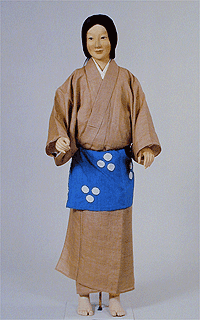
The first image is from the Kamakura period (1185–1333). This is too early for me, but it's closer to what would be found in Momoyama than Heian or Edo period.
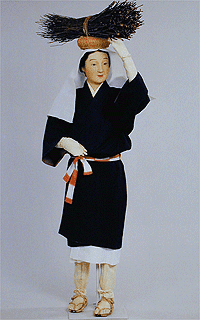
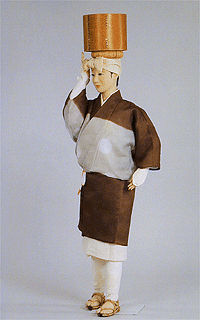
These are from the Muromachi era (1336–1573). Getting closer to the dates I'm aiming for. There were a few pictures of commoners in that era.
The other interesting ones I found are all in the Edo period. This period starts in 1603, which would be perfect for me, if I knew which costumes correspond to what date on the Costume Museum site. But since it goes up until 1868, it ends up wayyy out of my timeframe. While clothing didn't undergo any major changes between Heian and Edo, it changed dramatically during the Edo period to become standardized into what we now know as traditional Japanese costume. So using anything from that era is risky.
In any case, here are the two interesting costumes I found. (There's another one, but it's described as late-Edo, so I won't include it here.)
Questions:
How do I make the arm and leg coverings?
What is the standard width of fabric (if there is one) for a pre-Edo commoner?
How good/bad are the costumes in Shogun?
As usual, one of the best sources of information is the Kyoto Costume Museum. If you go there, check the Japanese language pages too, they have a lot of information that hasn't been translated to English. In Japanese, the costumes section starts here: http://www.iz2.or.jp/fukushoku/f_disp.php?page_no=0000001. In English, it's here: http://www.iz2.or.jp/english/index.htm. (Tip: Google Translate won't really make much sense, but will at least allow you to locate the period names in the menu!)
One problem with the English side of the Kyoto Costume Museum website is that they lump everything post-Heian and pre-Edo together into one huge Kamakura period, which covers more than 400 years of costume history. Digging through the Japanese side of the site, I found that they divide this period in three eras:
- Kamakura (1185–1333)
- Muromachi (1336-1573)
- Azuchi-Momoyama (1573-1603)
The first image is from the Kamakura period (1185–1333). This is too early for me, but it's closer to what would be found in Momoyama than Heian or Edo period.
| A woman in everyday wear, kosode and yumaki (=light wrapping skirt). Found here: http://www.iz2.or.jp/english/fukusyoku/busou/8.htm. There is not much to say about it. Ankle-length kosode, apron-like cloth at the waist, long hair, long sleeves (they seem longer than modern kimono sleeves). It doesn't seem to be puffed up at the waist, but seems to be cut ankle-length, which is good for me. |
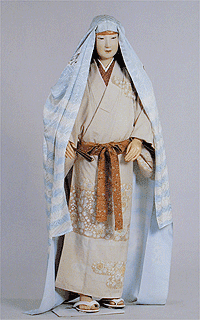
These are from the Muromachi era (1336–1573). Getting closer to the dates I'm aiming for. There were a few pictures of commoners in that era.
| Ohara-me or peasant woman of Ohara village selling firewood in Kyoto, from this address http://www.iz2.or.jp/english/fukusyoku/busou/24.htm. This is a little earlier than I'd like, but it would be much more practical than a long kimono for working in the kitchen (or running around in the woods, for that matter!). White socks in sandals in the dust and grit outside, though, will not stay white long! But see the next example for a solution. Note that she is also wearing an apron, even if we can't see this in the picture. | |
| Katsura-me or peasant woman of Katsura village selling food in Kyoto, from this address http://www.iz2.or.jp/english/fukusyoku/busou/25.htm. Much like the other one, except yay, no socks! The head covering would be practical for cooking too. I love the dye job on this, and reproducing it would be feasible. | |
| Woman of the warrior class in street wear: a kosode pulled up over her head. It's on this page: http://www.iz2.or.jp/english/fukusyoku/busou/23.htm. What interests me most is twofold. First, the obi is not really an obi at all, and tied in front. This is normal for the period. Second, the kosode seems to be made ankle-length, not longer and folded over like it's done on court ladies or in post-Edo kimonos. Also, she doesn't seem to be wearing tabi. And, the pattern on her kosode is very interesting, because it's not an all-over pattern like in earlier eras. They call it the tsuji-ga-hana zome dyeing method. Basically, it is tie-dyeing (shibori), but supplemented with many different methods (painting, embroidery, etc.) |
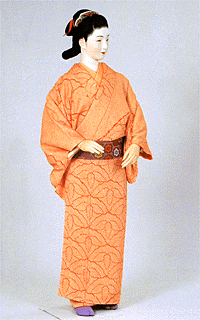
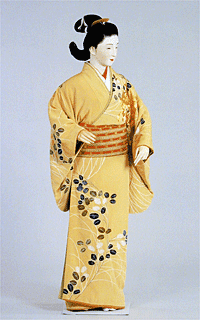
The other interesting ones I found are all in the Edo period. This period starts in 1603, which would be perfect for me, if I knew which costumes correspond to what date on the Costume Museum site. But since it goes up until 1868, it ends up wayyy out of my timeframe. While clothing didn't undergo any major changes between Heian and Edo, it changed dramatically during the Edo period to become standardized into what we now know as traditional Japanese costume. So using anything from that era is risky.
In any case, here are the two interesting costumes I found. (There's another one, but it's described as late-Edo, so I won't include it here.)
| Commoner in Kosode (short-sleeved kimono) of the early Edo era. http://www.iz2.or.jp/english/fukusyoku/kosode/3.htm. The explanations on the website for this one are interesting. The sleeves become shorter and the obi wider (and it's now worn in the back); the fabric width becomes standardized; and she's wearing coloured tabi. Also, the pattern is printed on the kimono, not woven. | |
| Commoner in kosode (short-sleeved kimono) of Genroku (1688-1704) or the (yes, it ends like that on the site). Found at this address http://www.iz2.or.jp/english/fukusyoku/kosode/4.htm. It's later than my period, but it looks more like the kimonos in Shogun than any other of earlier dates on the site. The description talks extensively about the resist dyeing techniques developed at the time, which means I probably can't use anything similar for my own kimono. This one might have the waist poofed up; there's no way to know under the obi. | |
Questions:
How do I make the arm and leg coverings?
What is the standard width of fabric (if there is one) for a pre-Edo commoner?
How good/bad are the costumes in Shogun?
Subscribe to:
Posts (Atom)